
To be eligible a household must be currently in receipt of less than 60% of the MIS.
The communities in Greater Manchester who built our proposal with us highlighted the need for a good mix of social and economic circumstances when it came to selecting participants, including people who face homelessness, families with children who have SEN, 18-25 year olds (including care leavers), people over 66, Disabled people, people with no recourse to public funds and people facing in-work poverty.
Our starting point for discussions around how much people should get were informed by The Minimum Income Standard (MIS),
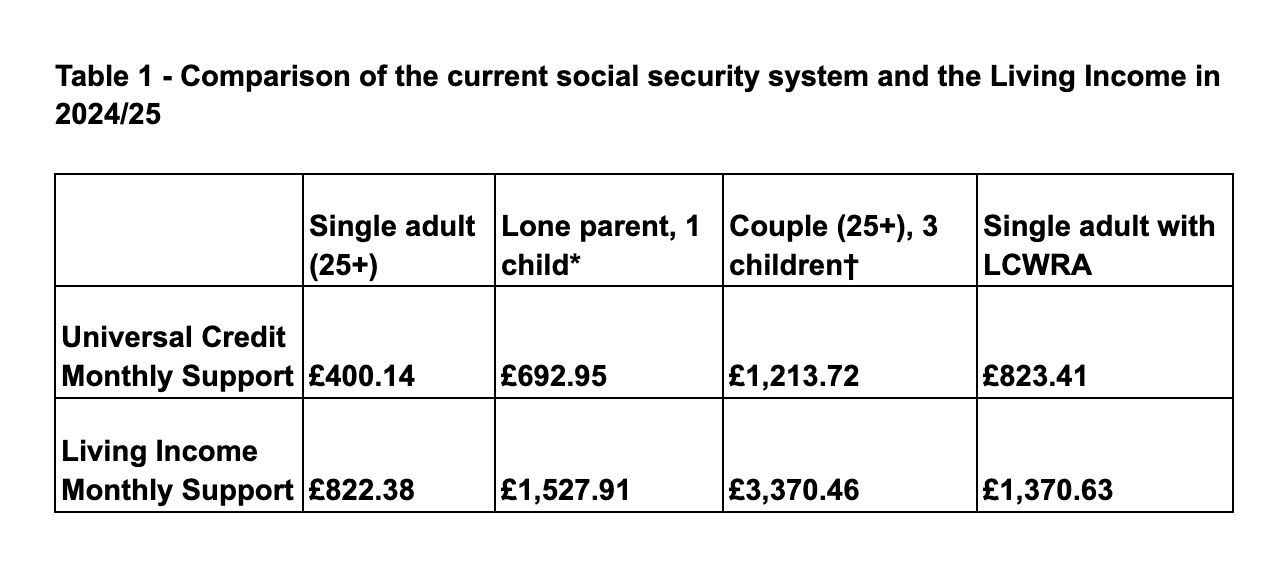
Living Income community members decided that 60% of the MIS would be the baseline set for the Living Income demonstration. People with reduced ability to earn due to caring responsibilities or disabilities/health conditions would be guaranteed a higher percentage of the MIS, up to 100% for those with the most significant barriers to work.
Table one below sets out what the Living Income would mean for different households with 60% of the MIS as the minimum baseline. This is what people will have to live on after housing costs.
Individuals can keep their participation in the pilot confidential and do not have to disclose they are receiving extra money to private landlords, friends, neighbours or family members they don’t live with. We cannot eliminate any potential targeting of vulnerable people, we can help them plan for having extra money and ensure they have informed consent around who their information will be shared with.
We want to create a lasting movement that organises and campaigns for an effective social security system—one where people can thrive, not just survive. To achieve this, we are using a community organising framework grounded in people, power and change. We believe lasting change happens when people build power together—and at the heart of our approach is developing leadership in communities.
This means that beyond the life of the campaign, there will be groups of organised people who have the tools, skills and motivation to continue tackling inequality, and continue influencing decision-making.
There have been numerous unconditional, guaranteed income projects and pilots across the world which have some similarities with what we are proposing. The evidence base from these projects shows reduced hospital admissions, reduced domestic violence, young people staying in education longer and more people actively participating in voluntary work within their communities.
During our implementation planning we have been drawing on shared learning from these projects whilst staying true to the proposal co-designed with our communities.
At our launch event in May 2025, Mayor Andy Burnham made the commitment to supporting our work, stating “at the earliest possibility as part of Live Well, I would want us to bring forward the country's first living income pilot”.
We have convened an implementation team which brings together the various perspectives, experiences and expertise needed to implement our proposal. People who are involved in Live Well have formed part of this implementation team. We are in ongoing discussions to ensure both approaches complement one another and draw on shared learning rather than re-inventing the wheel or attempting to duplicate support which is already out there.
Evaluation of the pilot would be key for capturing the impact and learning lessons for future policy decisions. The final decision on who the academic partner will be who evaluates the pilot has not yet been made. The implementation team has made some key decisions about the approach to evaluation. We want to explore whether the Living Income pilot provides:
· A springboard for people to stand on their own feet
· A means of people thriving, not just existing: to experience joyfulness
· A means of people building confidence and making their own choices
· A means of people living with dignity and purpose
· A means of people feeling respected
· A means for people’s lives to get better
We will use quantitative and qualitative research methods which support each other. We want as much of the evaluation activity as possible to be optional, enjoyable and therapeutic. Any statistical or quantitative data should be captured with minimum effort from the individual.
The ethos of our proposal is to transform the social security system so that it works for us all, whenever we need it. We want to create systems in Greater Manchester which provide the full range of support needed to ensure people need social security less. Our extensive engagement with communities has shown that attempting to shame, blame and coerce people into employment doesn’t work, especially for those with additional barriers to employment.We want everyone to live a rewarding life in which they feel valued and valuable. We believe that in order to achieve this people need holistic support which recognises people’s strengths rather than the threat of sanctions.
Outreach will take place through trusted organisations (not just through publicservices) to make sure communities in GM have access to information aboutthe pilot in a format which feels both accessible and relevant to them.
Potential participants will complete a short, accessible application designed togather enough information to confirm whether someone is eligible.
Quality face to face interactions will help people make an informed choiceabout whether to apply, accurate information will be offered by people withoutjudgement of their circumstances.
A random selection (or lottery) process will be completed to select 200households from those who have applied and are eligible. No-one will bemaking judgements about the ‘worthiness’ or ‘deservedness’ of participants.
We have engaged with philanthropic organisations (i.e. charitable trusts and foundations) and private wealth holders/potential individual donors. A roundtable event for the funders we have engaged will be held in June 2026.
The University of British Columbia conducted a study of a guaranteed income project for homeless people in Vancouver found that most people spent their income on rent, food, housing, transit and clothes. The cash recipients spent an average of 99 fewer days homeless compared to those not receiving the payments. The Minicome project in Manitoba saw a reduction in alcohol-related hospital admissions and Give Directly’s work in Kenya shows a 0% increase in alcohol and tobacco spend, paying for clean water and medical treatment.